
INIA Uruguay Shares New Data on Genesys
January 18, 2026
Here is a brief overview.
Earlier in 2025, Uruguay’s Instituto Nacional de Investigación Agropecuaria (INIA) signed a Data Provider Agreement (DPA) with the Crop Trust, paving the way for data sharing on Genesys. We are now pleased to welcome more than 20,000 accessions from INIA Uruguay as newly uploaded data on the platform.
The dataset uploaded in November 2025 spans hundreds of species, but several stand out for their scale and relevance. Wheat (Triticum aestivum) dominates the collection with 7,221 accessions, followed by rice (Oryza sativa, 3,589) and barley (Hordeum vulgare, 2,474). Together, these three crops represent some of the most widely cultivated cereals worldwide, highlighting Uruguay’s contribution to global food security research. Maize (Zea mays, 911), soybean (Glycine max, 703), oats (Avena sativa, 668), and sorghum (Sorghum bicolor, 581) also appear prominently. Beyond these staples, INIA’s holdings include a rich diversity of forage species, such as Lotus, Trifolium, Bromus, Paspalum, and Medicago, essential resources for livestock-based agricultural systems.
The presence of regionally important species like Bromus auleticus, Paspalum urvillei, Bothriochloa laguroides, and Steinchisma hians underscores Uruguay’s commitment not only to global crops but also to the genetic diversity of South America’s native and cultivated pastures.
While the largest share of accessions originate from Uruguay itself, the collection is truly global in scope. Materials sourced from Mexico (2,522), the United States (2,441), Argentina (1,243), Brazil (667), and China (483) complement the country’s national holdings. The dataset also includes accessions from more than 100 other countries, ranging from Ethiopia and India to Sweden, Tanzania, Armenia, and Fiji. This level of diversity significantly enriches the global research community’s ability to study crop adaptation, resilience, and agronomic performance across environments.
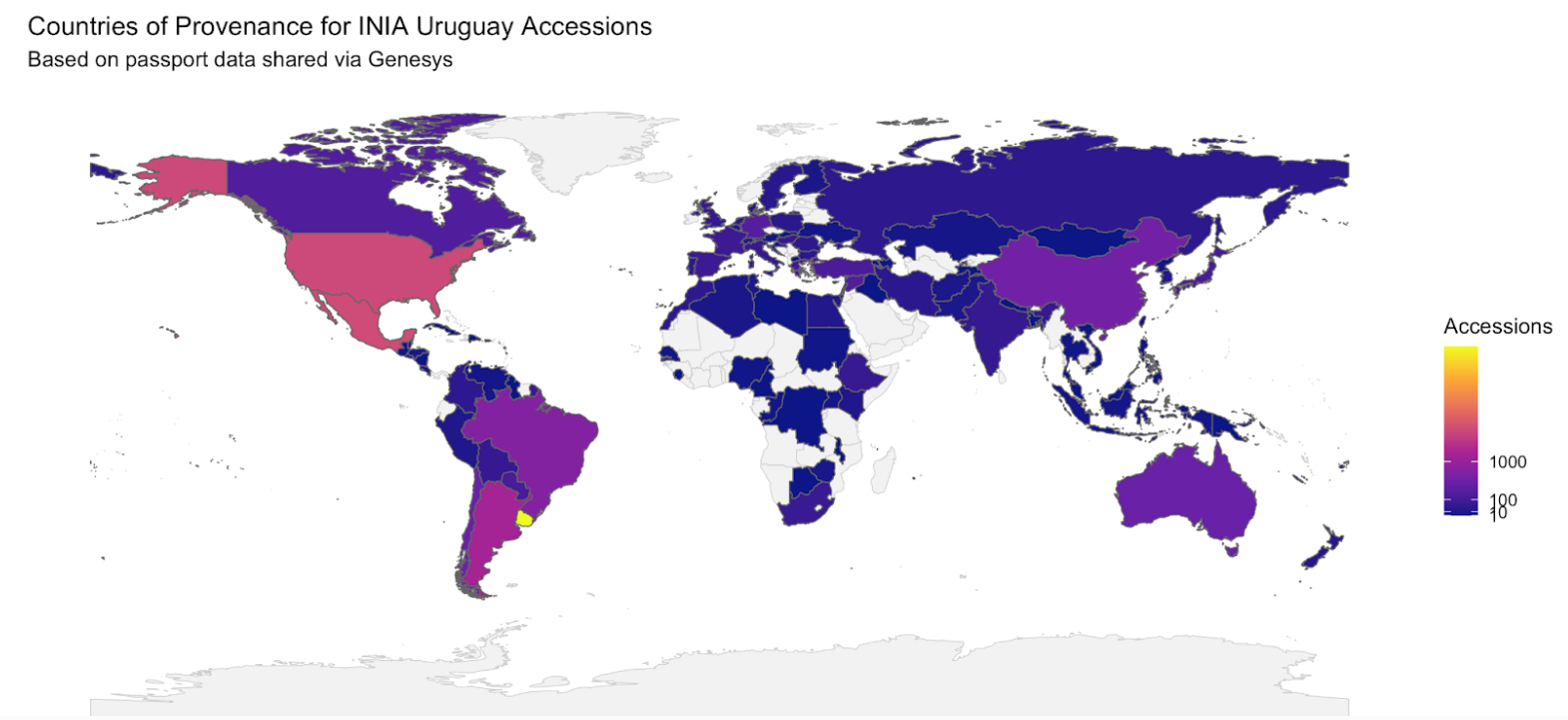
The collection is predominantly composed of breeding and research materials (12,673 accessions) and advanced cultivars (2,432), demonstrating INIA’s strong focus on applied crop improvement. At the same time, the presence of more than 1,300 landraces, 932 genetic stocks, and 899 wild relatives provides essential building blocks for long-term conservation and pre-breeding efforts.
All accessions uploaded by INIA Uruguay are reported as being held in long-term storage, meeting high standards of conservation and availability. Notably, 3,423 accessions are also safety duplicated at the Svalbard Global Seed Vault and belong to the Multilateral System (MLS) under the International Treaty on Plant Genetic Resources for Food and Agriculture (ITPGRFA).
We invite you to explore the full dataset on Genesys, and stay tuned for more updates as Uruguay continues to expand and refine its data contributions!